

Ipsa Tripathy
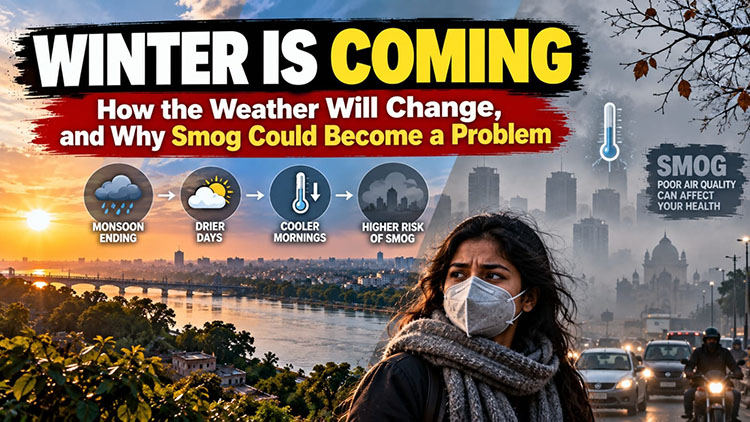
Bhubaneswar: The arrival of October marks a transition in India’s weather calendar, but in Odisha the change from the monsoon season to winter is not a sudden switch. The southwest monsoon season has just ended, and the state is entering the post monsoon period. The atmosphere will gradually become drier and, later in the season, cooler as rainfall decreases and winter weather begins to establish itself.
As of October 1, the India Meteorological Department’s forecast does not indicate an immediate onset of winter in Odisha. IMD has issued a thunderstorm and lightning warning for the state on October 1, while no warning is indicated for October 2 to 7. This means that the immediate weather pattern is still transitional rather than winter-like.
The transition can be seen in the temperatures as well. IMD observations for October 1 show that temperatures in several Odisha locations remain relatively warm. At Angul, for example, the maximum temperature recorded on September 30 was 34.7°C, while the minimum was 24.6°C, both above the local normal values.
This is why the word “winter” needs some qualification when discussing the coming weeks. October is the beginning of the post monsoon season, not the beginning of Odisha’s coldest period. The more noticeable fall in minimum temperatures generally develops later, particularly as skies become clearer, humidity changes and the influence of cooler air increases.
For the immediate future, the weather forecast points towards a relatively quieter period after the current thunderstorm activity. IMD’s Odisha subdivision warning issued on October 1 shows no warning for October 2 through October 7. The department also maintains five day district rainfall forecasts and an extended range forecast covering October 1 to 14.
The bigger change will come gradually. As the southwest monsoon withdraws, the atmosphere over much of India begins to transition towards the post monsoon pattern. In southern and eastern parts of the country, rainfall can still occur during October and later months, particularly under the influence of weather systems developing over the Bay of Bengal. Scientific research also shows that the October to December period is an important season for northeast monsoon rainfall over southern peninsular India, although Odisha’s weather is influenced by several different systems and cannot be described simply through the northeast monsoon.
The change in weather also affects the atmosphere close to the ground. During periods of stronger winds and atmospheric mixing, pollutants can disperse more effectively. When the atmosphere becomes stable, winds weaken and the vertical mixing layer becomes shallow, pollutants can remain concentrated near the surface. The Central Pollution Control Board identifies this combination of atmospheric stability, low mixing height and calm conditions as an important reason for increased pollution concentrations, particularly during winter.
This is where the familiar winter problem of smog begins to enter the picture.Smog is not simply fog. Fog is made mainly of tiny water droplets suspended near the ground. Smog involves air pollution, particularly particulate matter and other pollutants, that can accumulate under unfavourable atmospheric conditions. When cold or stable air limits vertical movement, pollutants released from vehicles, industries, construction, waste burning and other sources can remain closer to where people breathe.
Odisha has already documented this seasonal pattern. In an advisory issued in December 2025, the Odisha State Pollution Control Board stated that ambient air quality generally deteriorates during winter because of atmospheric stability and poor dispersion. The Board reported that air quality had shifted from the Good and Satisfactory categories towards Poor and Very Poor levels in several industrial and highly urbanised cities during that period.
The state’s monitoring data also show that particulate matter can become a significant contributor to air pollution during the cooler months. In Bhubaneswar, Odisha’s pollution-control data recorded an AQI of 207, classified as Poor, on October 31, 2024, with PM2.5 listed as the prominent pollutant. Other measurements during November and December showed Moderate AQI values, with PM10 or PM2.5 among the prominent pollutants.
This does not mean that every winter day will produce smog or poor air quality. Weather conditions vary from day to day, and pollution levels depend on emissions as well as atmospheric conditions. Wind, rainfall and atmospheric mixing can disperse or remove pollutants, while calm and stable conditions can allow them to accumulate. CPCB documentation specifically notes that rainfall can substantially reduce pollutant concentrations through atmospheric scavenging.
For people, the concern is mainly exposure to polluted air rather than the visual appearance of haze itself. Fine particulate matter such as PM2.5 can penetrate deep into the respiratory system. Prolonged exposure to particulate air pollution is associated with respiratory and cardiovascular health effects, making seasonal deterioration in air quality an important public health concern.
The coming weeks, therefore, are unlikely to bring an abrupt arrival of winter to Odisha. Instead, the state is entering a gradual transition from monsoon conditions towards the cooler and generally drier part of the year. Rainfall patterns will change, minimum temperatures will eventually decline and atmospheric conditions will increasingly become favourable for pollution accumulation during stagnant periods.
The first signs of winter may be felt in cooler mornings and falling night temperatures, but the more important environmental change may be less visible. As the atmosphere becomes more stable, the same pollutants released into the air can behave differently. The onset of winter is therefore not only a change in temperature. It is also a change in how the atmosphere handles pollution.
