

Ipsa Tripathy
Bhubaneswar: India’s river movements have never been limited to one kind of protest. Some began with communities demanding protection of water and livelihoods. Others emerged around dams, pollution, industrial development or the changing flow of rivers. Over time, these movements have also influenced government programmes, public debate and the way rivers are discussed as ecological systems rather than simply sources of water.
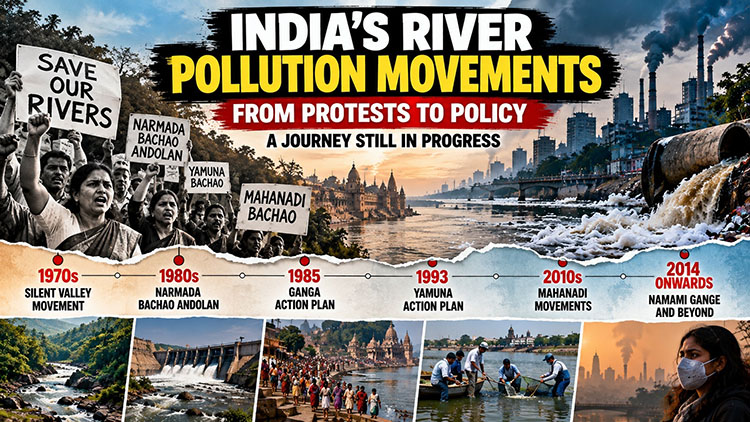
One of the most important milestones in the history of river pollution control in India came in 1985, when the government launched the Ganga Action Plan (GAP). Its initial objective was to reduce pollution in identified stretches of the Ganga through measures including sewage interception and diversion, sewage treatment plants, sanitation facilities and improved crematoria. The programme later expanded to other rivers through the National River Conservation Plan.
The Ganga Action Plan was a government programme rather than a grassroots movement, but it marked an important change: river pollution had become a national policy issue. By 2006, the National River Conservation Plan had expanded to polluted stretches of 34 rivers across 20 states. The programme included rivers such as the Yamuna, Gomti, Damodar, Sutlej, Krishna, Cauvery and Godavari.
The Yamuna soon became one of the most visible examples of the struggle to restore a polluted river. The Yamuna Action Plan began in 1993, with sewage interception, diversion, treatment plants and sanitation among its major components. But government programmes were accompanied by public campaigns demanding greater attention to the river.
One of the better-known examples was the Yamuna Bachao Yatra of 2013, when activists and religious leaders marched from Mathura towards Delhi to draw attention to the condition of the river. The campaign brought the issue to Jantar Mantar and argued that years of expenditure on cleaning the Yamuna had not produced the desired condition of the river.
Other river movements were not primarily about pollution but still changed the environmental politics surrounding India’s rivers. The Narmada Bachao Andolan, which emerged in the 1980s around the Sardar Sarovar Project, focused on displacement, environmental impacts and the consequences of large dams. The movement became one of India’s most prominent environmental campaigns and brought questions about development, rehabilitation and ecological consequences into national and international debate.
The Save Silent Valley movement in Kerala similarly demonstrated how public mobilisation could influence environmental decision-making. Protests against a proposed hydroelectric project began in the 1970s, with campaigners presenting scientific information about the forest ecosystem and biodiversity. The project was eventually abandoned, and Silent Valley received national park protection.
In Odisha, river activism has also been closely connected with questions of water use, ecological flow and livelihoods. The Mahanadi Bachao Andolan became prominent during disputes over the diversion of Mahanadi water for industries. In 2010, thousands of people from districts including Cuttack, Jagatsinghpur, Kendrapara and Puri participated in a major mobilisation against proposed industrial water withdrawals.
The movement later developed alongside the interstate Mahanadi water dispute between Odisha and Chhattisgarh. In 2017, the Mahanadi Banchao, Jibika Banchao Abhiyan travelled through Odisha to build public awareness about the river’s flow and its importance to livelihoods. Campaigners called for attention to ecological flow and questioned approaches that treated the river primarily as a resource for competing users.
People’s organisations from Odisha and Chhattisgarh have also attempted to move the debate beyond interstate politics. A meeting reported by the India Water Portal brought organisations from both states together to support a Mahanadi Bachao Yatra. Their demands included a transparent water policy, protection of environmental flows, assessment of new dams and barrages, and action against industrial water pollution.
The nature of river activism has continued to change. Alongside marches, demonstrations and public campaigns, environmental organisations and communities increasingly use scientific monitoring, legal proceedings and public data. River pollution is now discussed through indicators such as biochemical oxygen demand, dissolved oxygen, faecal coliform, sewage loads and ecological flow rather than only through photographs of visibly polluted water.
Government policy has also moved towards a basin-wide approach. The National Ganga River Basin Authority was established in 2009, followed by the Namami Gange Programme in 2014. Namami Gange brought together sewage treatment, riverfront management, ecological flow, sanitation, afforestation, biodiversity conservation and public participation.
By 2026, public participation had become an explicit component of river rejuvenation. The government describes Jan Ganga as the public participation pillar of Namami Gange, involving cleanliness drives, plantation activities and educational programmes. The programme’s current approach presents river conservation as something that requires community participation alongside infrastructure and scientific monitoring.
There are also signs that the problem remains far from resolved. In February 2026, the government reported that 218 sewerage infrastructure projects had been taken up under Namami Gange, with 138 completed and operational. At the same time, the continued identification of polluted river stretches shows that treatment infrastructure alone has not eliminated river pollution across India.
The history of India’s river movements therefore tells a story of changing priorities. The early campaigns often asked whether forests, rivers and communities were being sacrificed for development. Later campaigns increasingly focused on sewage, industrial effluents and water quality. More recent approaches combine public participation with treatment infrastructure, ecological-flow requirements, scientific monitoring and river-basin planning.
The river movements have not followed a single path, and their outcomes have varied. Some changed public debate, some influenced policy, some achieved specific environmental protections, while others continue to campaign decades after they began. What has remained constant is the central fact that rivers are not simply channels carrying water. They support ecosystems, agriculture, fisheries, settlements and cultural life.
The story of river pollution movements in India is therefore still being written. In 2026, the challenge is no longer simply to make people notice polluted rivers. The harder question is whether institutions, communities and governments can turn that awareness into sustained improvements in the ecological condition of the rivers themselves.
