

Ipsa Tripathy
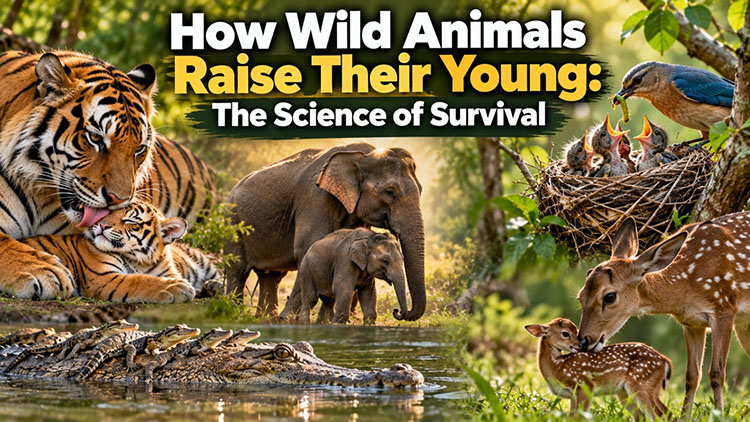
Bhubaneswar: In the wild, the early stages of life can be among the most vulnerable. Young animals may face predators, competition for food, disease and difficult environmental conditions before they become independent. Across evolution, animals have developed many different forms of parental care that can increase the chances of offspring surviving and developing. Parental care can include providing food, protecting young, maintaining suitable conditions for development and, in some species, helping offspring acquire information and skills.
Not every animal provides parental care. Some species produce eggs or young and provide little or no assistance afterwards, while others invest considerable time and energy in their offspring. The amount and type of care vary among species and are closely connected to their life histories and environments. In mammals, parental care is widespread, while birds show several different systems, including maternal, paternal, biparental and cooperative care.
For many animals, care begins before the young are born or hatch. Birds construct nests that provide locations for eggs and developing chicks, while incubation maintains conditions necessary for embryonic development. After hatching, parents may protect the nest, feed the chicks and respond to threats. These behaviours can be particularly important because young birds often depend on adults for food and protection during early development.
Mammalian parents face a different biological requirement. Mammals produce milk, allowing mothers to provide nutrients to offspring after birth. In species where young are highly dependent, parental care can continue for an extended period. Parents may provide food, protection and opportunities for young animals to develop physical and social abilities before becoming independent. The costs can be substantial because the energy and time devoted to current offspring can affect a parent’s ability to survive and reproduce in the future.
Protection is another important component of parental care. Parents may defend offspring against predators, keep them in protected locations or move them when conditions become dangerous. Such protection can increase offspring survival during periods when young animals are physically less capable of escaping danger. The benefits of parental care, however, depend on the species and circumstances. Evolutionary research shows that care is favoured when its benefits to offspring can compensate for the costs paid by parents.
The responsibility for raising young does not always belong to females. In some species, males provide substantial or even exclusive parental care. Male care has evolved independently in different groups of vertebrates, including birds, amphibians and fish. In some fish, males guard eggs or territories containing developing offspring. Among birds, care can be provided by males, females or both parents, depending on the species.
Some animals also receive help from individuals other than their parents. Cooperative breeding occurs in several bird and mammal species, where additional group members assist with raising offspring. This is sometimes called alloparental care. Helpers may contribute to feeding, protection or other forms of care. Such systems demonstrate that raising young can involve social groups rather than only a single parent or pair.
Young animals themselves also differ greatly in their level of development when they are born or hatch. Scientists describe part of this variation using the terms altricial and precocial. Altricial young are relatively undeveloped and generally require considerable parental care. Precocial young are more physically developed and can move around much sooner after birth or hatching. These are different developmental strategies, and neither represents a universal model of successful reproduction.
Development does not end when an animal becomes physically mobile. In some species, young animals acquire information through interactions with older individuals and through their own experience. They may learn aspects of feeding, movement and social behaviour while living alongside adults. Scientists distinguish between learning that occurs through observation and experience and cases where adults actively influence or facilitate learning, so not every example of information transfer should be described as deliberate teaching.The biology of parental care also involves changes inside the body. Hormonal and neurological systems influence parental motivation and behaviour in many vertebrates. Research on mammals and birds has identified biological mechanisms associated with attachment, feeding and protection of young. These mechanisms differ among species, but they demonstrate that parental behaviour has a physiological basis rather than being simply a human-like emotional response.
Ultimately, raising young is an evolutionary trade-off. Parents invest energy, time and resources in offspring because that investment can increase offspring survival and future reproductive success. At the same time, parental care has costs for the adults themselves. The balance between these costs and benefits has produced an extraordinary diversity of reproductive strategies across the animal kingdom.
A bird incubating eggs, a mammal nursing its young, a fish guarding its eggs and a group of animals helping to raise offspring may appear to have little in common. Biologically, however, they represent different solutions to the same fundamental challenge: producing offspring that can eventually survive independently. The science of animal parenting shows that there is no single way to raise young in the wild. Each strategy reflects the species’ evolutionary history, developmental biology and ecological conditions.
